A modern metal fountain can hold water in a bowl, spread it over a sphere, release it through a curved opening, or distribute it among dozens of small outlets. Each choice shapes the fountain’s appearance as much as the metal silhouette itself.
Two sculptures with similar outlines can create very different water displays. One produces a single falling sheet; another fills an opening with separate streams. A third adds a second cascade around the edge of a supporting disc. Understanding these relationships helps you compare designs beyond their appearance in a photograph.
The following 15 designs from D&Z Sculpture include 10 existing design directions and 5 new design concepts. The article begins with concentrated cascades, gradually introducing curved water features, open frames, interwoven rings, and natural-themed forms with multi-point water outlets, covering both indoor and outdoor arrangements.
Table of Contents
Follow the Water Through the Design
Concentrated Cascades: Give the Water a Clear Starting Point
Curved Forms: Let the Metal Guide the Water
5. Stainless Steel Waterfall Fountain
Open Frames: Give Falling Water a Defined Space
9. Crescent Two Spill Fountain
Loops and Secondary Cascades: Decide Which Effect Leads
Natural Forms: Distribute Water Without Losing the Shape
Compare Where Water Starts and Where It Lands
Use Materials and Finishes to Clarify the Water Effect
Turn a Reference Image into a Defined Design
FAQs About Modern Metal Fountains
Before comparing these 15 fountains, we can first trace three points: where the water begins to appear, where it leaves the sculpture, and where it falls. The distance and shape between these three points determine the fountain's most significant visual changes.
The important turning point of the bowl fountain occurs at the overflow point; the water flow of the sphere fountain first travels along the metal surface, then separates near the bottom; the rain curtain fountain fills the previously empty space with falling water lines.
Some designs also feature two distinct water cascades. The water first enters the upper disc, then falls from the edge into the pool below. The second cascade may become an important part of the overall composition and needs to be considered in conjunction with the central sculpture.
Through these observations, we can first determine what we want people to notice: a concentrated waterfall, a flowing surface, a series of transparent rain curtains, or a combination of several water effects.
The first three designs use clearly defined spillways. Each pairs a relatively simple falling sheet with a different metal form, making the outlet itself an important part of the composition.
1. Bowl Fountain
The tilted black bowl features a wide, concave surface with an opening on the front. Water gathers behind the opening and falls into a collection basin below. The water flow transforms from the relatively calm surface inside the bowl into an exposed waterfall, a clearly visible transformation.
The spillway interrupts the circular rim and gives the rounded bowl a clear front. Its width changes the balance between the visible bowl and the falling sheet, so it should be considered alongside the sculpture’s proportions during design. Click to customize a bowl fountain
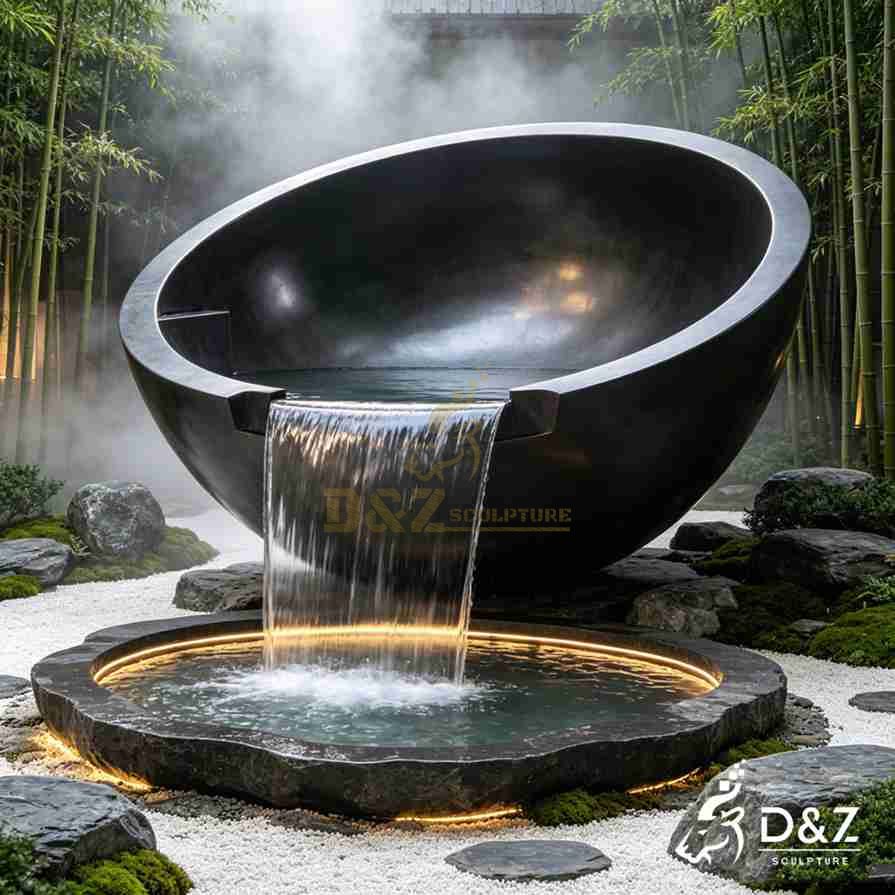
Metal Bowl Water Fountain | Large Modern Black Fountain DZJ-826
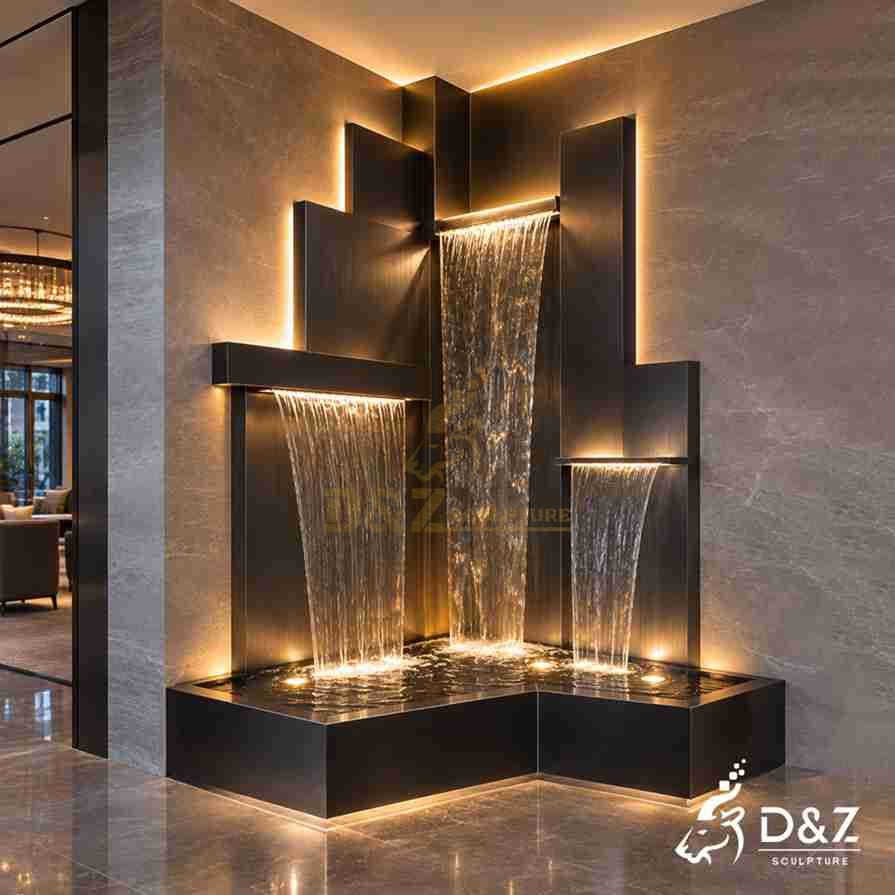
2. Corner Waterfall Fountain
Three rectangular waterfalls at different heights are distributed within a geometric metal composition. The water feature unfolds along the corner of the wall, with the collection basin extending along the corner as well, creating a continuous and layered water feature at the corner.
The key design decision is hierarchy. The taller central waterfall can lead the composition, while the lower side falls provide balance. Their relative widths and flow levels should be considered together so that the three waterfalls form a coordinated display. Click to customize a corner waterfall fountain
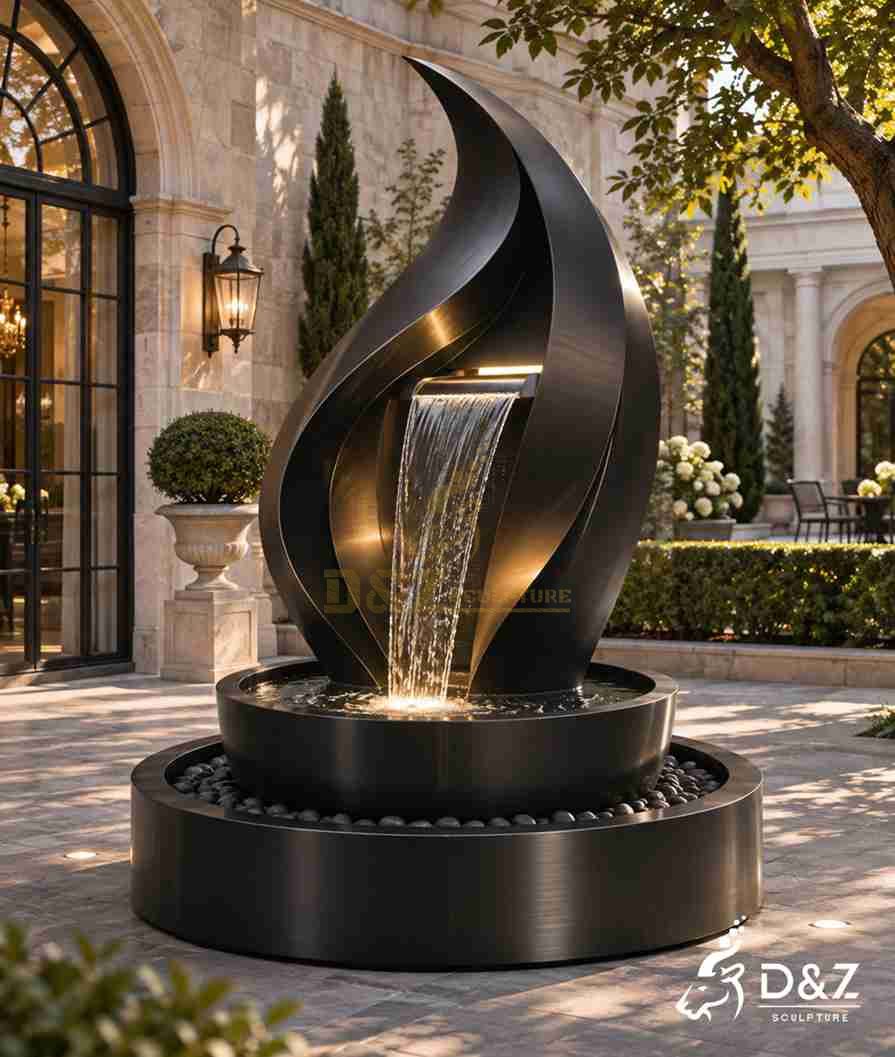
3. Leaf Waterfall Fountain
The black metal body of the leaf waterfall fountain tapers upwards, forming a twisted leaf shape. A horizontal cascade is placed within the curved opening, allowing a rectangular curtain of water to fall vertically into a round bowl. A wider lower container surrounds the upper bowl, with pebbles creating a contrasting texture between the two.
Its distinctive feature stems from the difference in form: the sculpture twists upwards, while the water flows directly downwards. Maintaining this relationship allows the piece to have a clear visual center. Click to customize a leaf waterfall fountain
The following three designs all make the curved main body an important part of the water feature effect. Water spreads along the curved surface or flows out from positions that complement the curved shape.
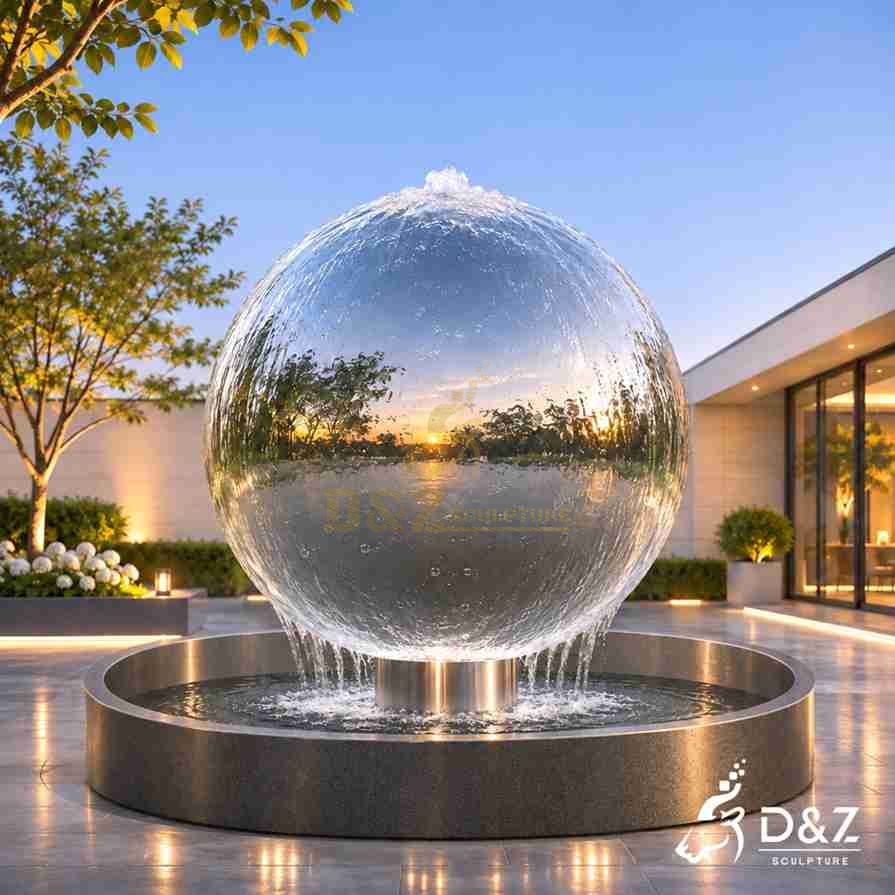
4. Modern Sphere Fountain
The water in the modern sphere fountain appears from the top of a mirrored sphere, spreads downwards along the rounded surface, and then separates below the sphere and above a shallow circular pool. The flowing water layer alters the spherical reflection while preserving the complete spherical outline.
This design creates the effect through water flowing along the spherical surface; the illustrated concept does not include spherical rotation. Its characteristic stems from the relationship between the continuous curved surface and the water layer. Click to customize a modern sphere fountain
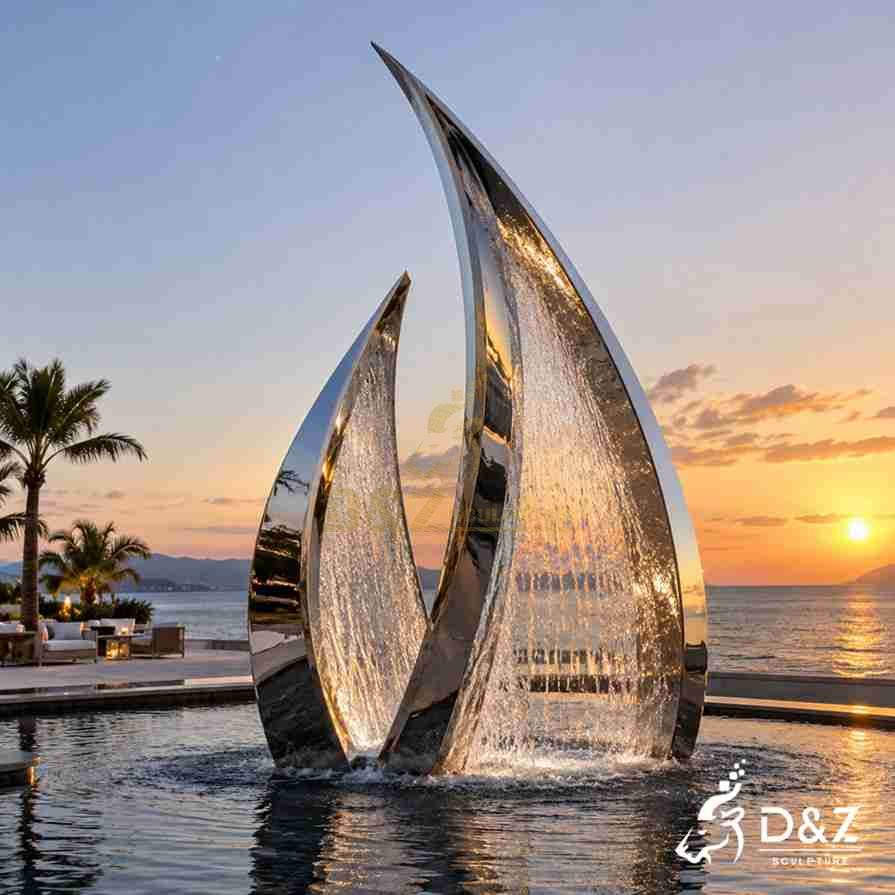
5. Stainless Steel Waterfall Fountain
The stainless steel waterfall fountain features two pointed, sail-like metallic forms rising from the pool. Water flows down the inner surface, creating two independent flowing water surfaces between the reflective metal edges. The staggered structure allows one to naturally become the main feature.
When designing this fountain, the water coverage of the two inner curved surfaces should be determined first. Two approaches can be compared: creating two waterfalls with similar visual intensity, or a stronger main waterfall paired with smaller auxiliary water flows. Click to customize a stainless steel waterfall fountain
Stainless Steel Waterfall Fountain | Modern Outdoor Water Feature DZJ-879
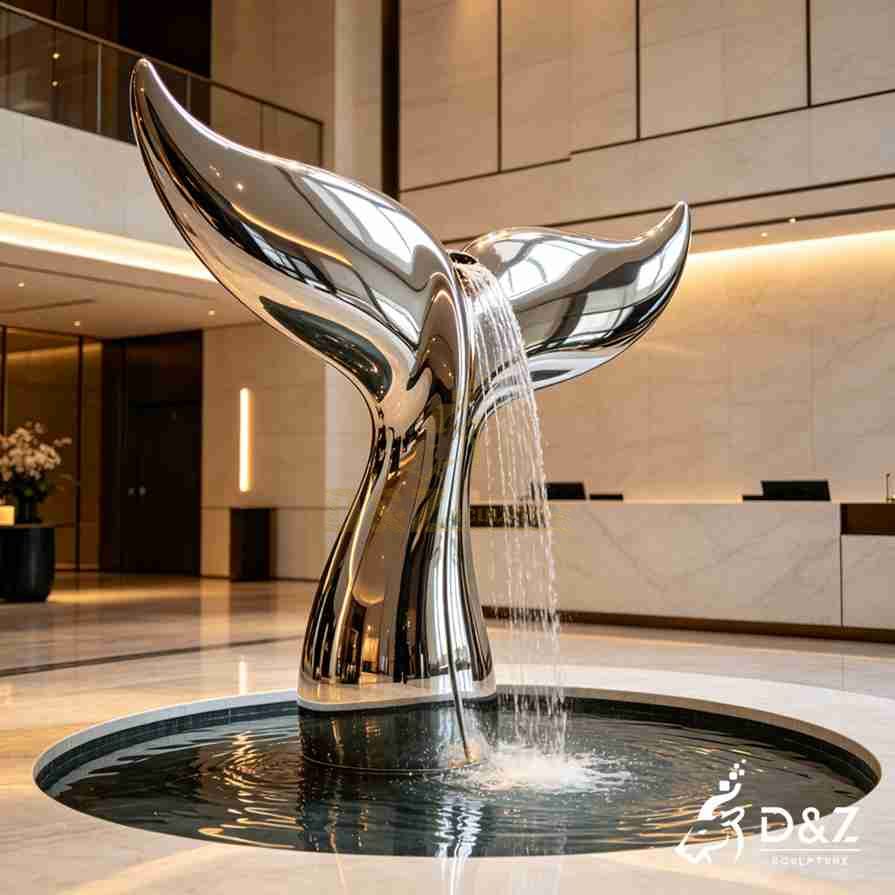
6. Whale Tail Fountain
The whale tail fountain's tail extends from the narrow supporting body to both sides, with the main water flow cascading vertically from the central fork. The horizontally extending tail and the concentrated cascading water curtain create a clear directional contrast.
For indoor metal water fountains such as this whale-tail concept, the central outlet and receiving basin should be reviewed together. The outlet’s position determines how naturally the falling water connects with the curved tail. The tail's overall width does not define the falling-water footprint or the required collection area. Click to customize a whale tail fountain
Modern Metal Whale Tail Fountain for Outdoor DZJ-746
These designs place falling water within metal openings. The frame defines the outline, while separate streams create a changing layer across the space inside it.
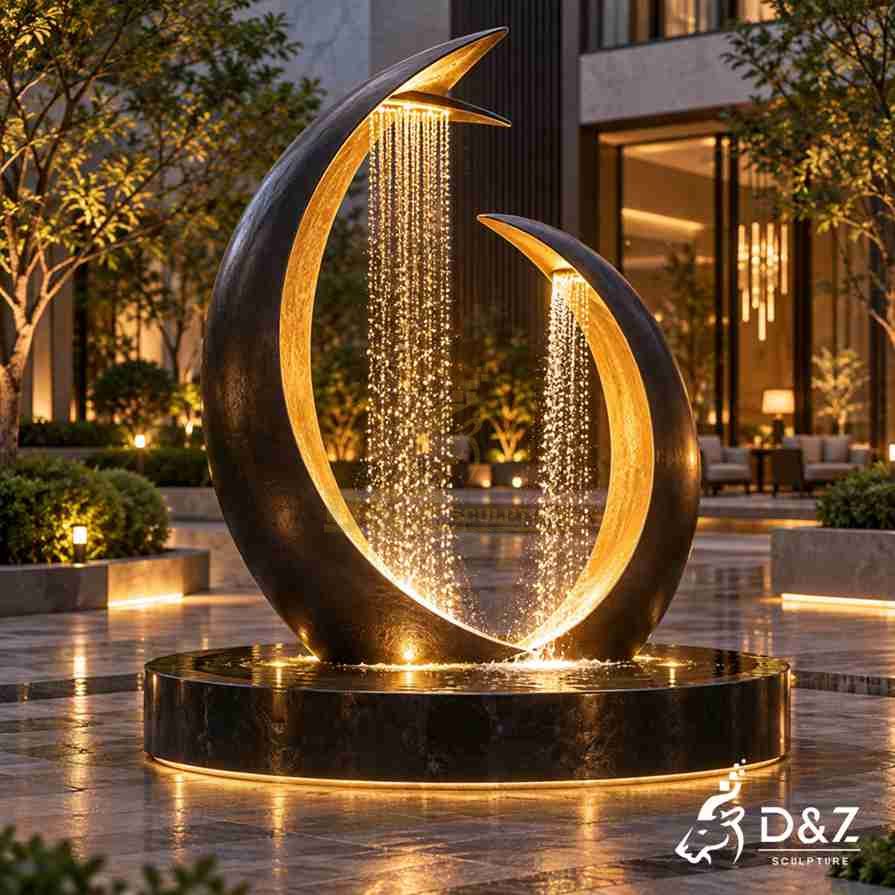
7. Modern Metal Fountain
Two gradually tapering, curved metal bodies extend upwards towards each other, each enclosing a set of illuminated falling water curtains. The tips are higher than the water outlets, allowing the sculptural silhouette to continue extending above the water curtains.
The pointed tips extend beyond the outlets, giving this modern outdoor fountain a sculptural outline above the falling water. Moving the outlets to the tips would change that relationship, so their position should be considered part of the design. Click to customize a modern metal fountain
Modern Metal Fountain | Outdoor Rain Curtain Water Feature DZJ-850
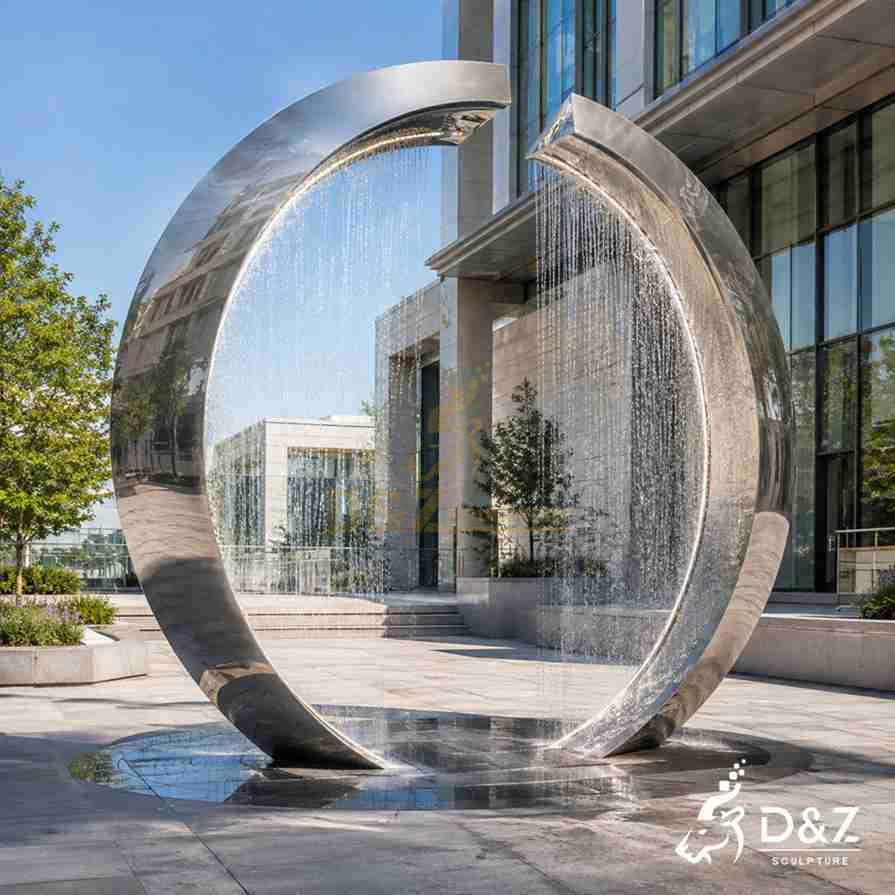
8. Arch Fountain
The arch fountain features a split circular frame with a prominent opening at the top. Rain-like water lines cascade from the interior of the arched structures on both sides, while the central opening maintains a visual connection between the fountain and the building behind it.
Water-line density changes how transparent the arch appears. Closely spaced streams create a denser screen, while wider spacing reveals more of the background. The preferred effect should be established before the outlet arrangement is finalized. Click to customize an arch fountain
Custom Modern Metal Arch Fountain for Outdoor DZJ-809
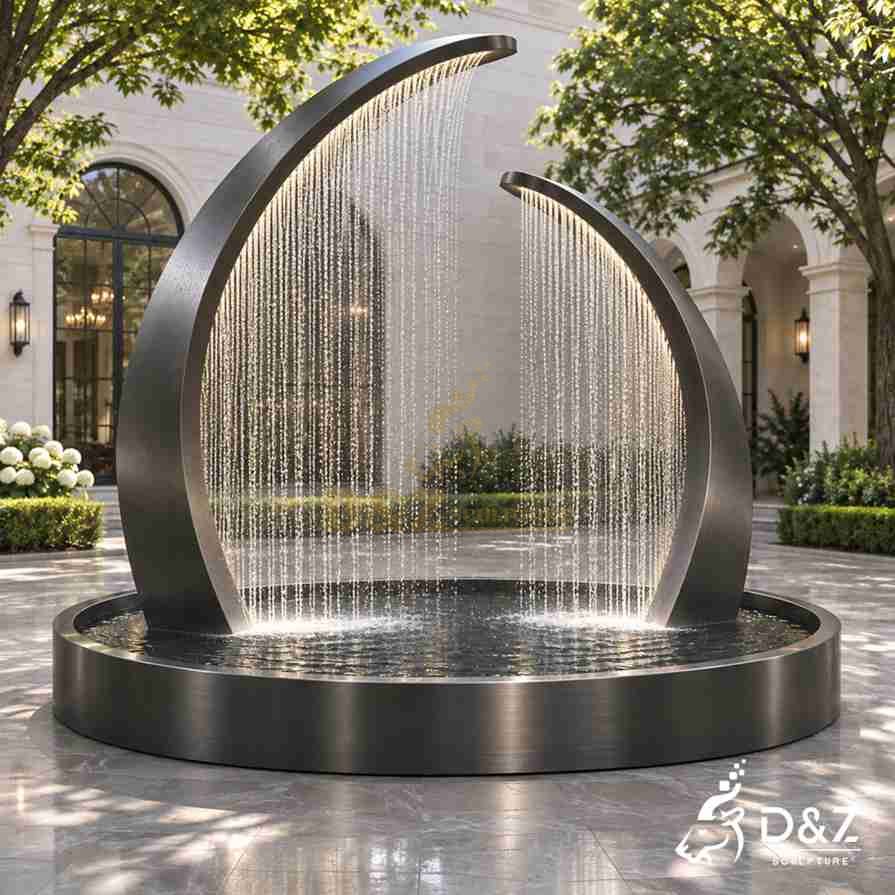
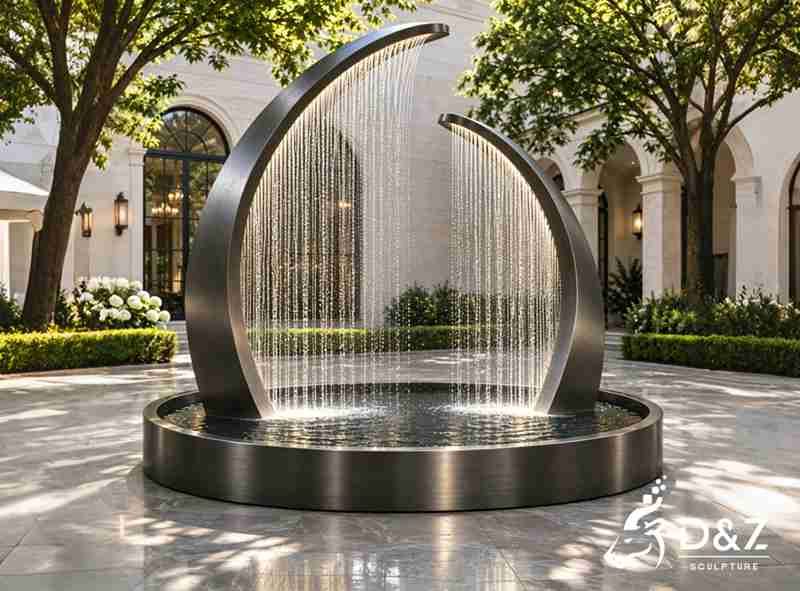
9. Crescent Two Spill Fountain
The crescent two spill fountain features two dark, curved sections at different heights above a circular pool, each supporting a set of cascading water curtains, creating two overlapping water areas within the same outer contour.
Compared with the split-ring design, this fountain has a more pronounced difference between its two upper edges. The taller crescent can establish the main fall, while the shorter one introduces a second rhythm. Their relative flow levels should support that intended balance. Click to customize a crescent two-spill fountain
The next three designs all incorporate additional water flow variations around or below the central sculpture. A clear hierarchy makes these combinations easier to understand.
10. Round Fountain
The round fountain features a towering, mirrored, twisted ring above a wide disc. Water flows down from within the ring, simultaneously cascading down the outer edge of the disc into the pool below.
The internal fall and the disc’s perimeter overflow create two distinct effects. A stronger overflow emphasizes the horizontal base, while a more prominent internal fall draws attention upward through the twisted ring. Decide which effect should lead, then adjust the other to support it. Click to customize a round fountain.
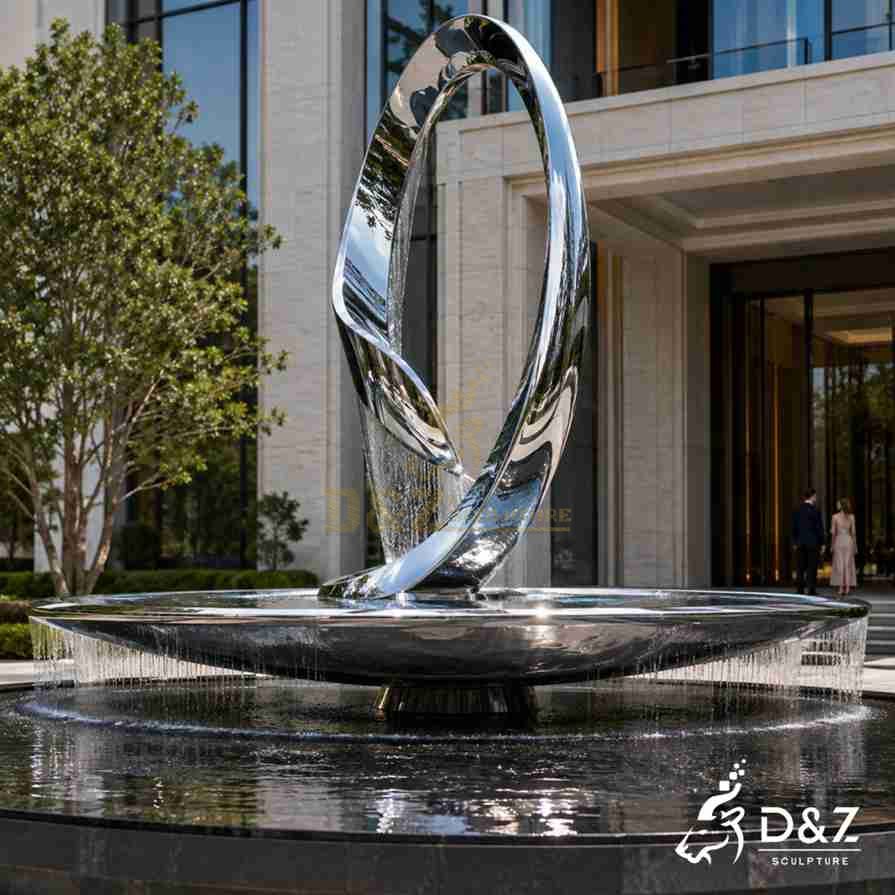
Large Modern Metal Round Fountain for Outdoor DZJ-823
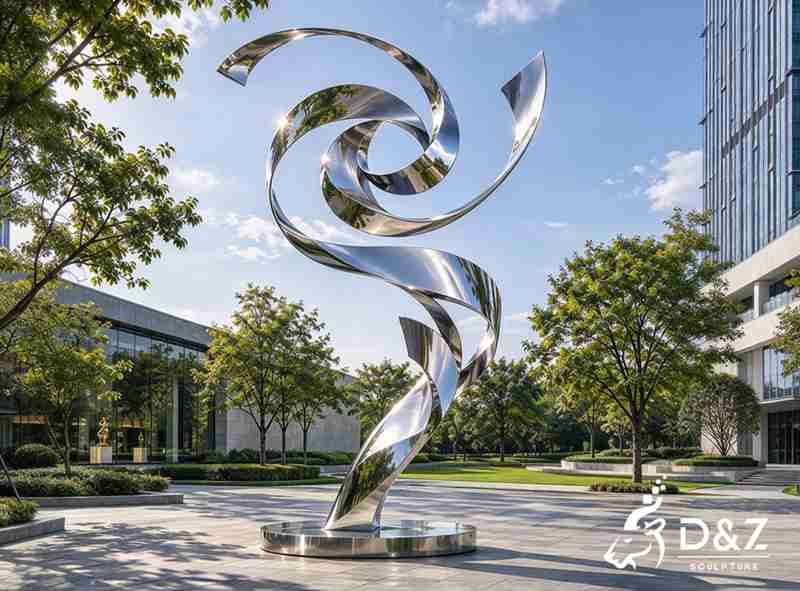
11. Modern Black Fountain
A modern black fountain features two dark, twisting blades that frame illuminated waterfalls above a raised circular platform. Smaller jets around the perimeter add another layer of movement to the central sculpture.
The blades, inner falls, platform edge, and surrounding jets can all attract attention. Establish a primary effect so that the remaining water features support the overall composition. For example, the central falls can take the lead while the peripheral jets remain visually restrained. Click to customize a modern black fountain
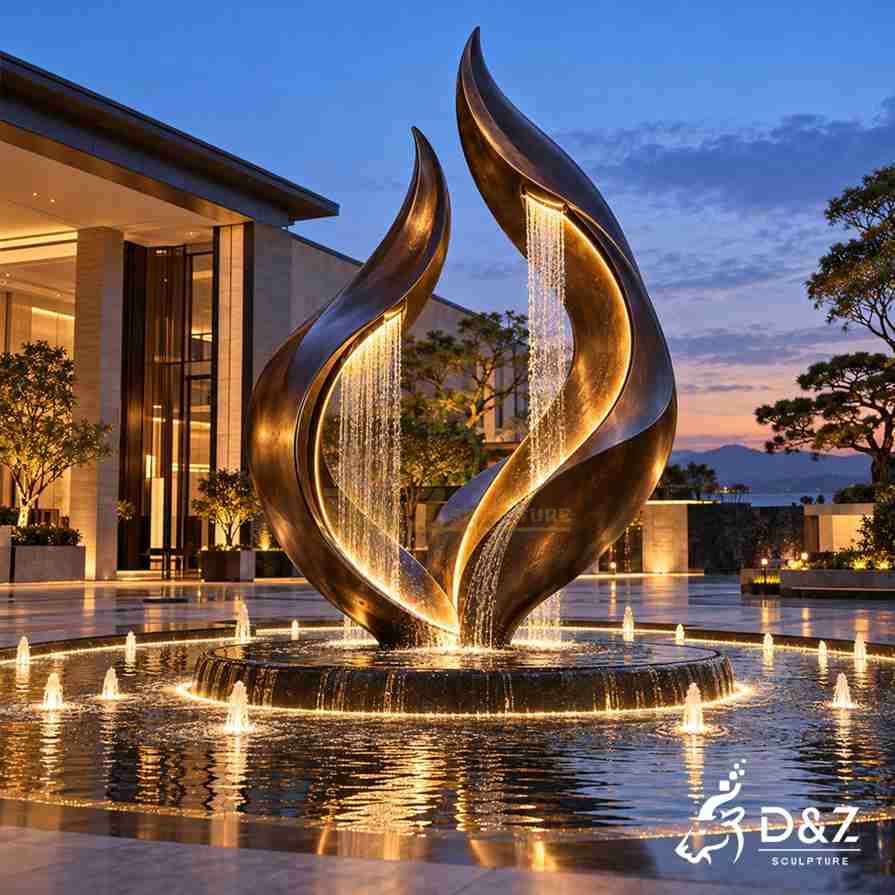
Modern Black Fountain | Custom Spiral Water Feature DZJ-884
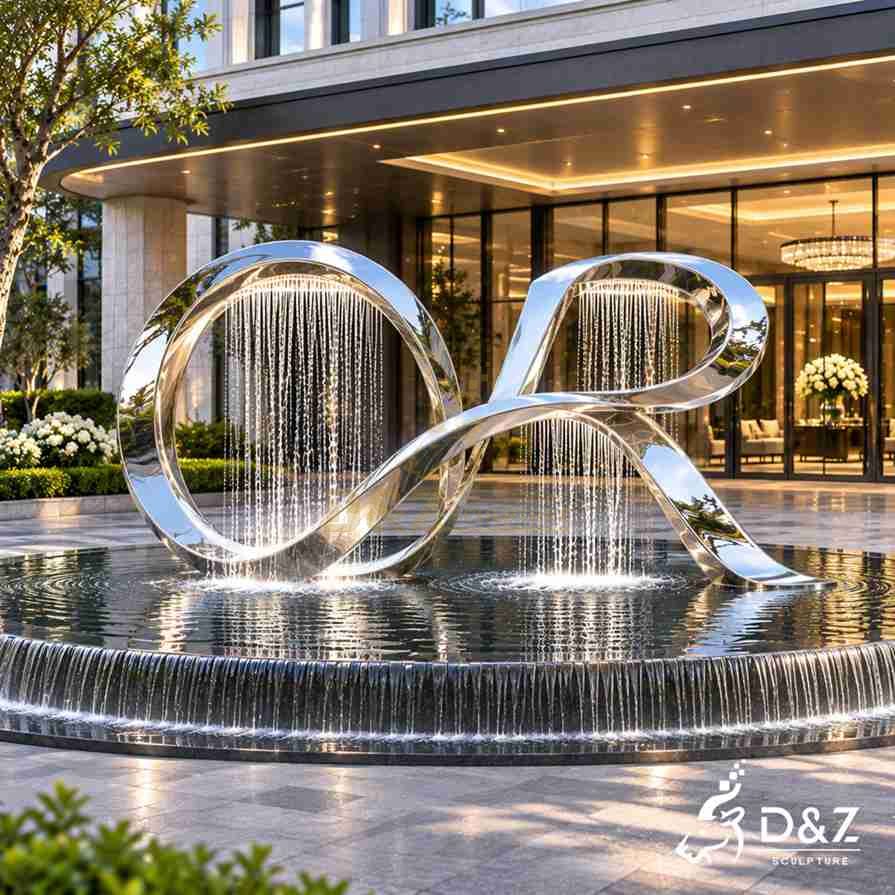
12. Letter Fountain
The letter fountain features horizontally extending metal ribbons that form two connecting openings. Two sets of water curtains fall from within the rings, while the outer edge of the wide circular platform forms another ring of overflowing water.
The most striking relationship is the correspondence between the letter-shaped openings and their respective water curtains. The central intersection creates a curved variation while retaining some of the metal surface. Click to customize a letter fountain
The last three designs employ easily recognizable natural imagery. The design requires different parts to play a clear role within the same water feature.
13. Lotus Water Fountain
The lotus water fountain features mirrored petals that radiate outwards around a tall central form. Water falls from selected outer petals into the circular pool, while the remaining metal surface retains its reflective effect.
Selectively placing water outlets makes it easier to distinguish the sculpture's main body from the water's edge. If every petal spouts water, the overall effect will be denser, potentially affecting the individual petal's visibility. Click to customize your lotus water fountain
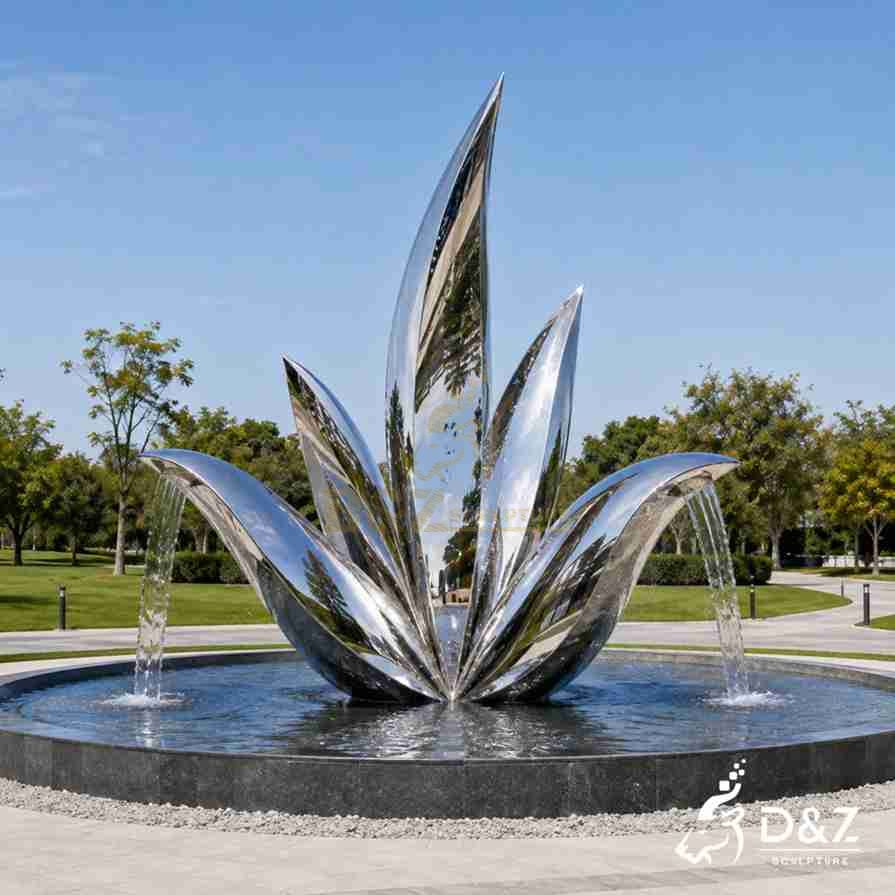
Metal Lotus Water Fountain for Outdoor DZJ-807
14. Dandelion Water Fountain
The Dandelion Water Fountain consists of two groups of spherical inflorescences composed of numerous slender stems and small spouts. The water flow they create extends beyond the metal structure, expanding the visual volume of the entire water feature. The overall effect comes from the coordination between the many individual water outlets.
The repeated outlet pattern makes consistency particularly noticeable. A missing or uneven stream can stand out more than a similar variation in a broad waterfall. Review the two heads together, including their spacing and the way their water patterns overlap. Click to customize the Dandelion water fountain
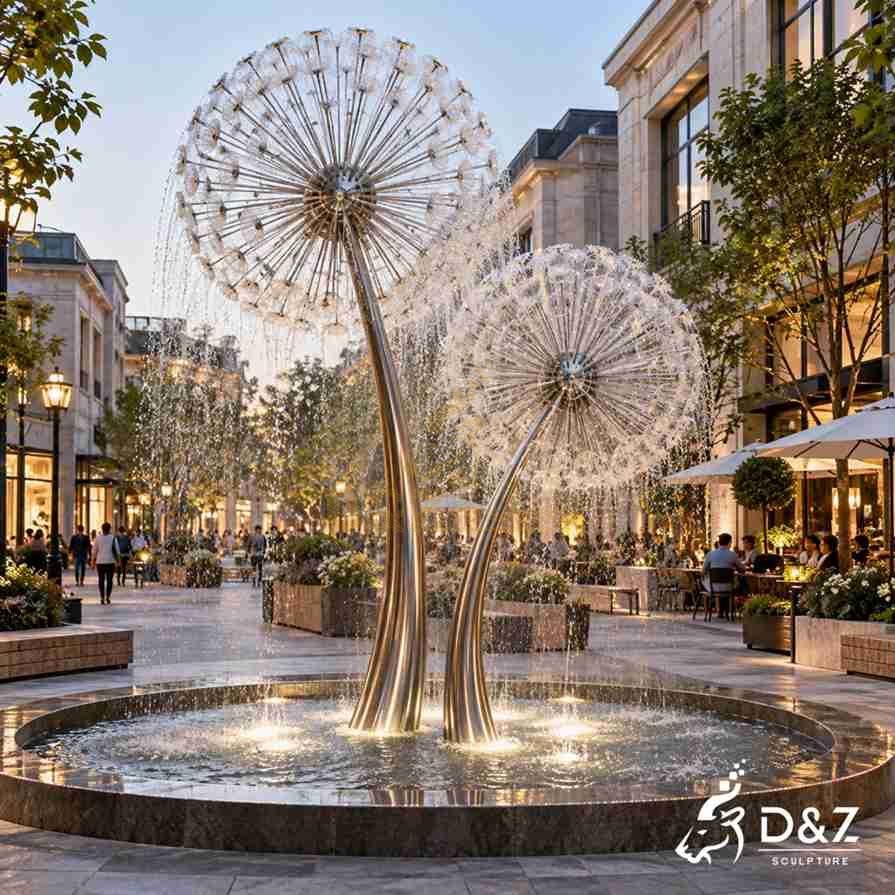
Large Dandelion Water Fountain | Metal Sculpture Art DZJ-866
15. Fish Fountain
The fish fountain features a wide arch formed by a school of mirrored fish, with vertical water lines cascading below. The overall composition includes a recognizable fish theme, an architecturally inspired arched silhouette, and a central open space.
These three layers need to be considered separately. Increasing the density of the fish strengthens the solid arch; increasing the density of the water lines enhances the rain curtain effect. Both changes affect the visibility of the central opening. Click to customize a fish fountain
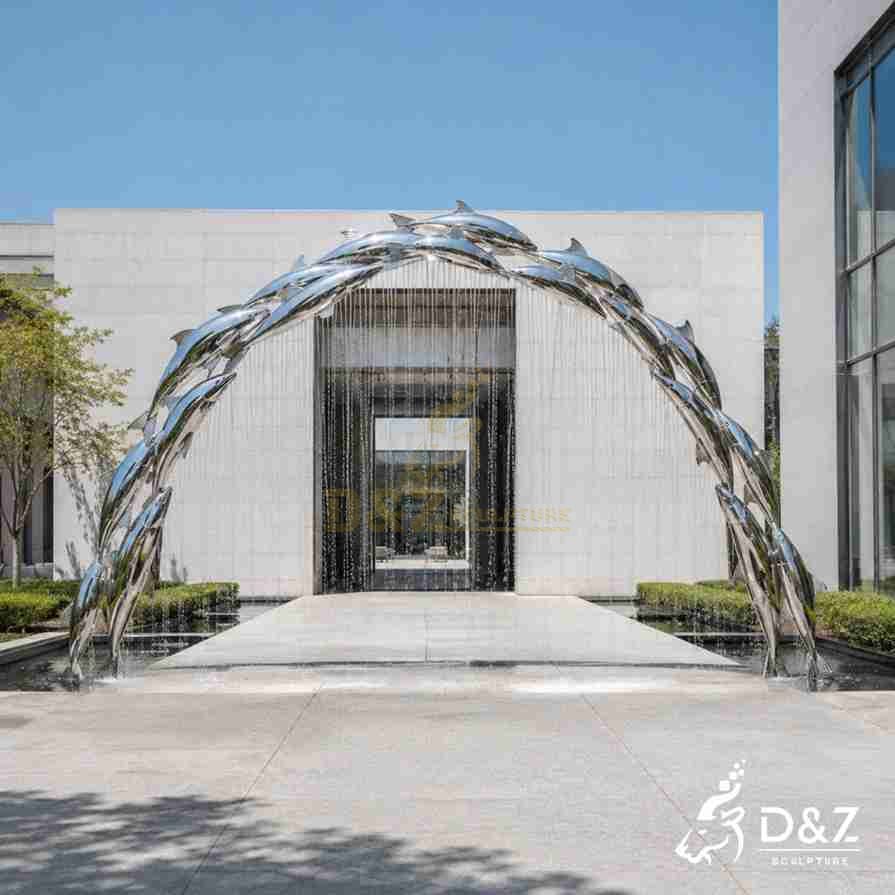
Fish Fountain | Modern Metal Arch Art for Outdoor DZJ-815
After selecting a silhouette, examine where the water lands. A raised bowl, an overflowing disc, and a ground-level collection surface give falling water different visual endings.
In a large modern fountain, the receiving basin and any secondary cascade are part of the composition. The bowl fountain has one clear drop into a lower pool; the round fountain adds another fall at the disc edge; and the double-loop design combines two internal curtains with a perimeter cascade. Compare the full water route alongside the height of the central sculpture.
Mark the location of the first cascade on each design, and whether there is a second visible cascade afterward, to decide whether the water collection edge should be the focus of the composition or a relatively quiet supporting element. This comparison can explain why two sculptures with similar shapes can evoke different feelings after operation.
Material selection should reflect the installation environment, water quality, and intended appearance. Confirm the stainless steel grade and surface treatment for the project, then consider how the finish helps define the moving water.
On mirror-polished stainless steel, reflections overlap with the flowing water. The boundary between wet surfaces and exposed metal becomes part of the design. A sphere uses water to transform its continuous reflective surface, while curved waterfall blades use polished edges to frame the flow.
Dark finishes create a different relationship. The leaf waterfall fountain uses a black body to frame one bright falling sheet, while the modern black fountain combines several illuminated effects within and around dark curves.
Review the proposed finish alongside the intended outlet and water pattern. A dry sample shows the surface color and texture; a representative water test reveals how reflections, lighting, and flowing water interact.
Reference images can establish a design direction; further development requires translating this direction into content that can be discussed and verified.
First, document the details that truly appeal to you: the single cascade of the water bowl, the water covering the sphere's surface, the blank space in the center of the ring, or the paired water curtains within double rings. Then determine which parts can be adjusted while retaining this characteristic, such as the catchment area, surface color, or the strength of the second cascade.
For commercial water feature projects, the design documents should describe the expected water flow appearance, catchment arrangement, and maintenance locations. Undetermined dimensions, pipe connections, and operational requirements should also be clearly marked and confirmed item by item.
This gives everyone a clear starting point: identify the design feature to preserve, then define where the water appears, how it moves, and where it is collected.
Q: How large should the basin be to limit splashing?
A: The collection area for a large outdoor fountain depends on the drop height, flow rate, and site wind conditions. Confirm the arrangement through water testing and on-site commissioning.
Q: How can I confirm the water effect of a modern metal fountain?
A: Confirm the outlet pattern, curtain width, and landing position, then review water-test footage for the proposed design. Final adjustment is still needed after installation.
Q: Why does a rain curtain fountain develop gaps or uneven streams?
A: Common causes include blocked outlets, uneven distribution, or an installation that is out of level. Check each cause before changing the pump output.
Q: Will strong winds affect the fountain?
A: Yes. Depending on the site, outdoor metal fountains may need changes to the water display, a larger collection area, or wind-linked controls.
Q: Are large metal fountains suitable for coastal locations?
A: They can be, provided the material grade, weld treatment, finish, and maintenance plan are selected for the salt exposure and water conditions.
Q: Can hard water affect metal surfaces and nozzles?
A: Yes. Hard water can leave mineral deposits on metal fountain sculptures and around nozzles. Use water-treatment and cleaning methods compatible with the specified materials and coatings.
Q: Can an existing pool accommodate a new fountain?
A: Before installing an outdoor modern fountain, check structural capacity, waterproofing, collection area, pipework, and the volume of water draining back when the pump stops.
Q: Will shipping in sections affect the appearance or water effect?
A: Agree on joint locations, connections, and on-site finishing before production. After assembly, check watertightness and the complete water display.
Q: How should the fountain be prepared for freezing weather?
A: Follow the project-specific shutdown and winterization instructions, including any required draining. Remove and store the pump only if specified for that equipment.
WhatsApp: 0086 13613220352
Email: info@dzsculpture.com
Choose the design whose relationship between metal and water best fits your project. Tell D&Z Sculpture which details you want to preserve and which elements you would like to adjust.
Share the selected image number, project location, available space, and preferred water effect. We can use these references to discuss a suitable design direction and the details to confirm before installation.
Leave a message

Any landscape ideas in your mind, describe to D&Z sculpture team directly, you can imagine we can create.


Copyright © 1996-2026 D&Z Sculpture Co., Ltd. All Rights Reserved | Sitemap |