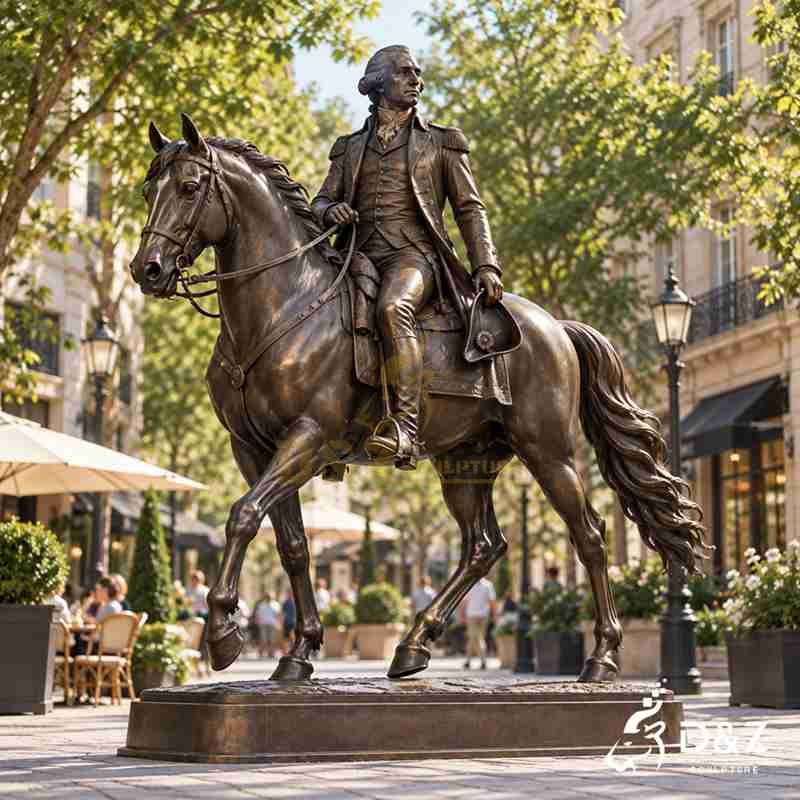
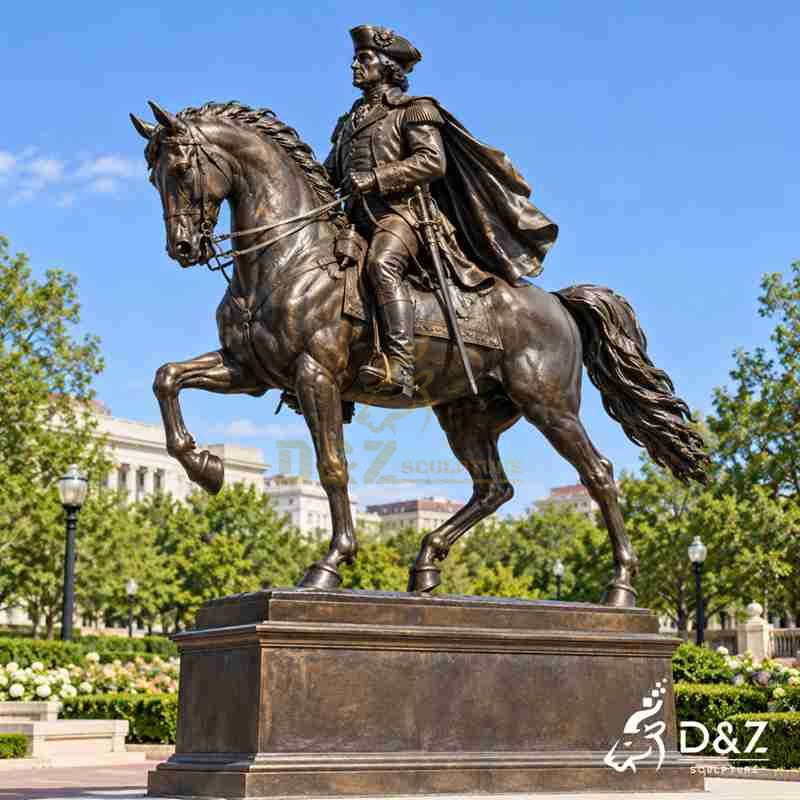
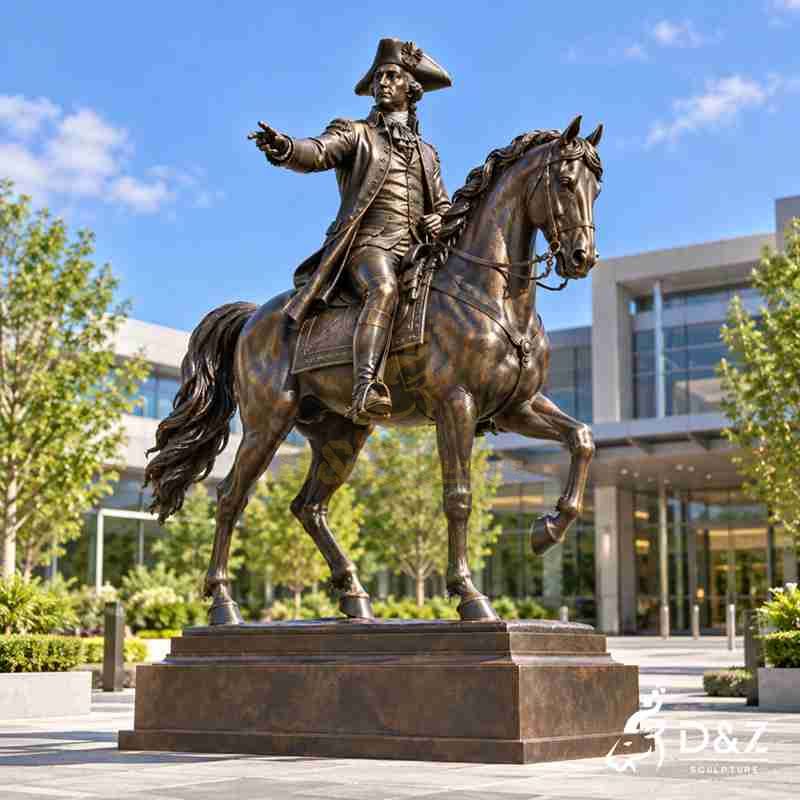
D&Z Sculpture | Bronze George Washington Equestrian Statue, Symbolizing Courage and Pioneering
| 30 Years of Experience | One-Stop Customization Service | Long-Term Warranty | Global Shipping |
Product Description | George Washington Equestrian Statue
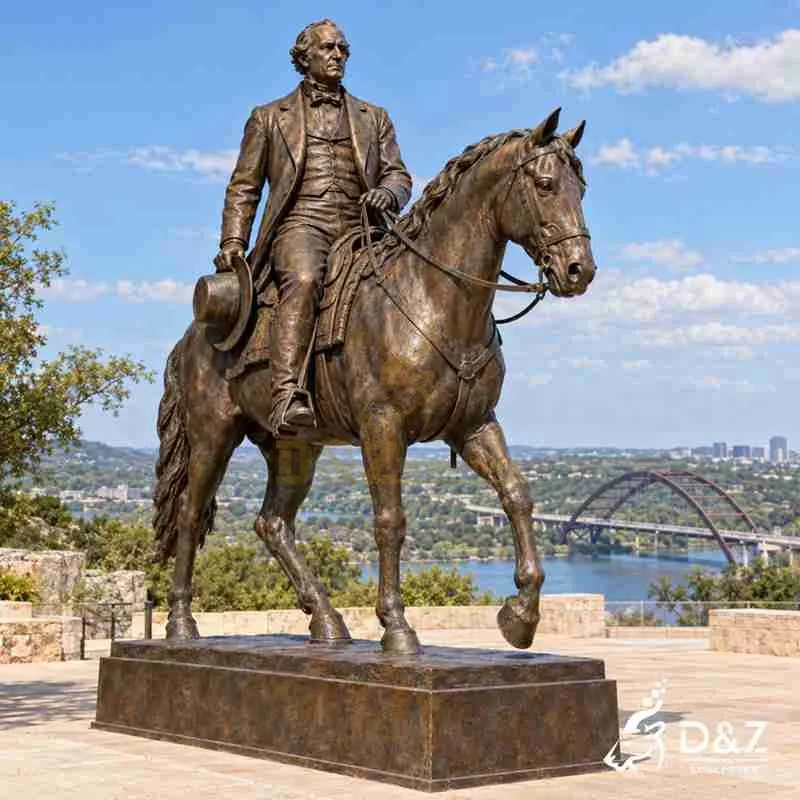
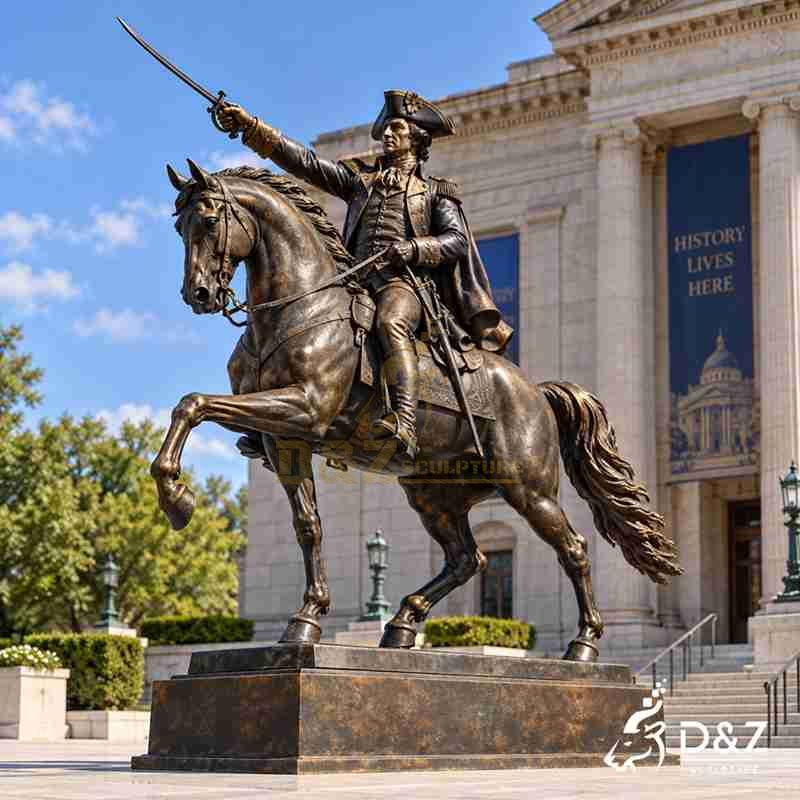
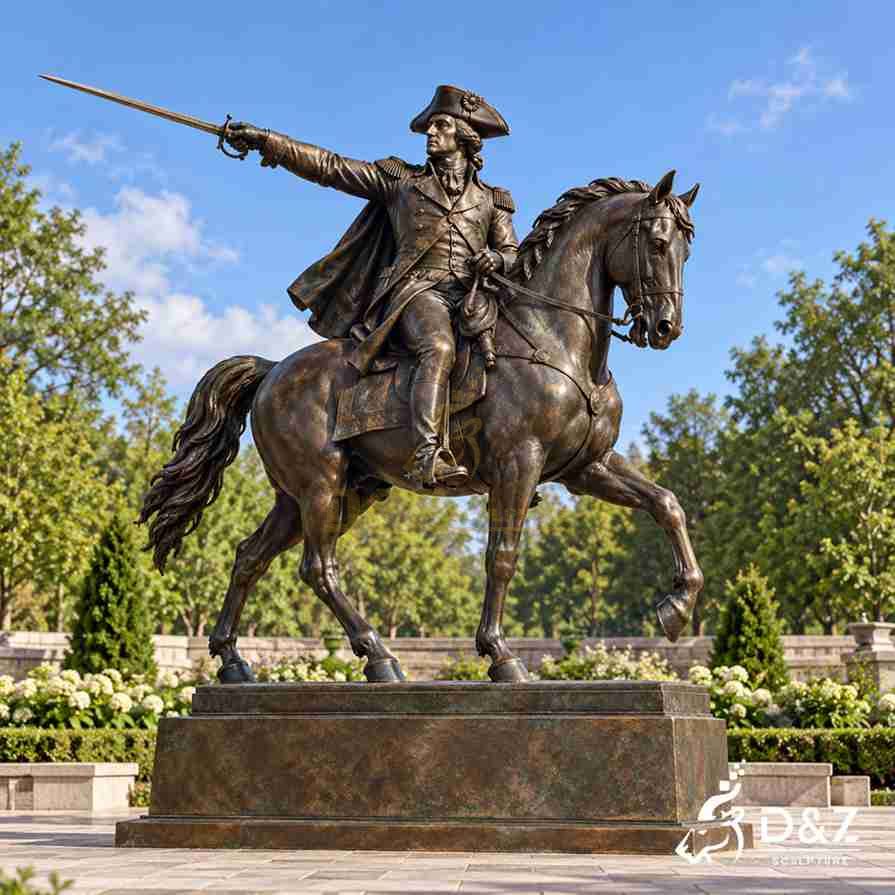
D&Z Sculpture's bronze George Washington Equestrian Statue centers on the image of a battlefield commander. Washington sits upright on horseback, wearing a tricorn hat and 18th-century military attire draped as a battle cloak. One hand holds the reins, while the other points his sword high forward.
Compared to traditional static figure statues, the George Washington statue for sale creates a clear sense of direction through the raised sword, head turn, riding posture, and the horse's raised hoof. The figure remains stable and resolute, while the horse displays forward leaping power. This contrast between the two states gives the entire George Washington on a horse statue a stronger sense of commemoration and narrative.
The horse adopts a proud forward posture. The left foreleg is clearly raised, while the other three hooves provide stable support. The horse's neck, chest, and leg muscles maintain a sense of tension, contrasting with the relatively stable seated posture of the figure, creating a dynamic yet composed image.
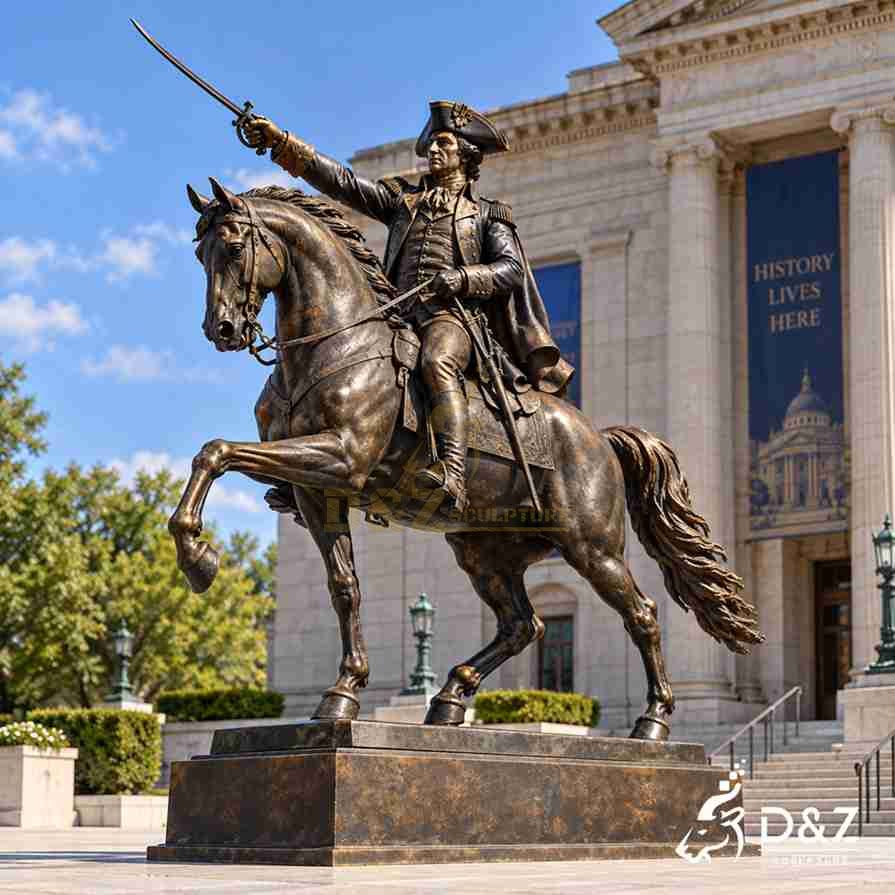
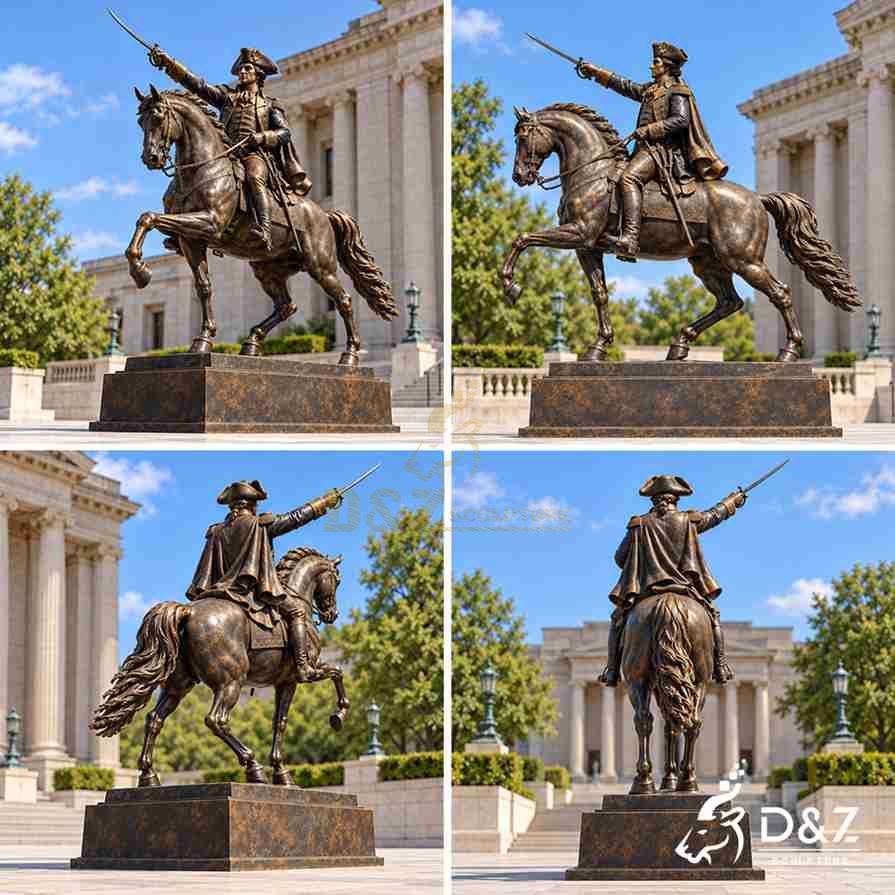
Different Angle Views
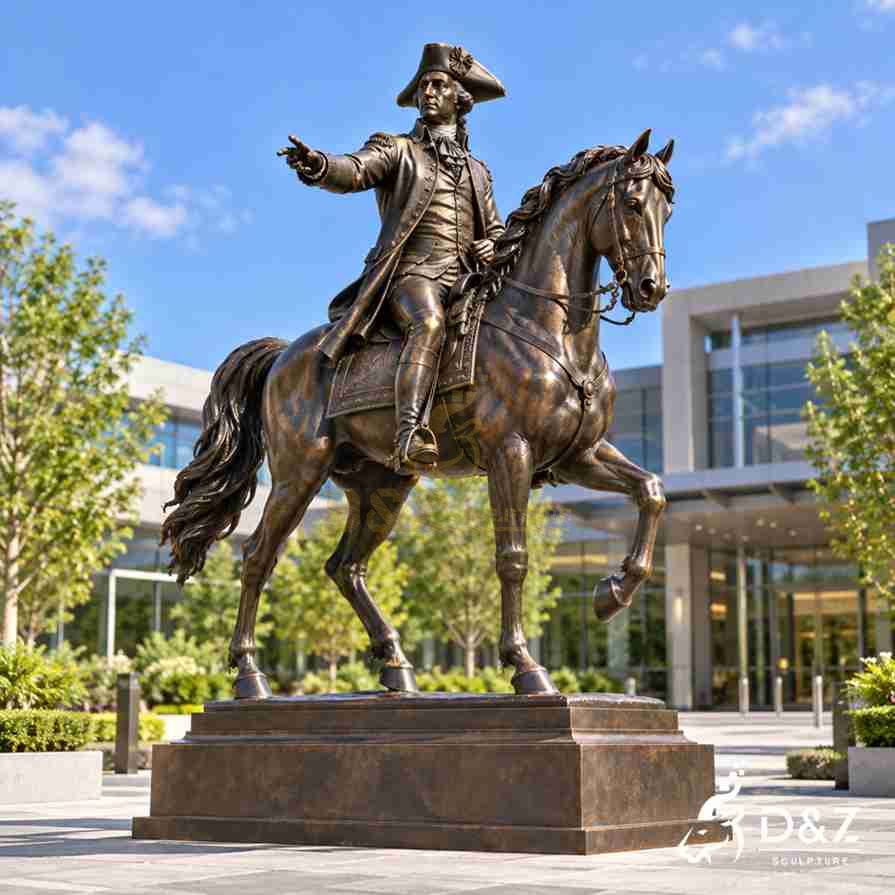
The frontal view directly shows Washington's face, tricorn hat, uniform, and commanding posture with his sword raised.
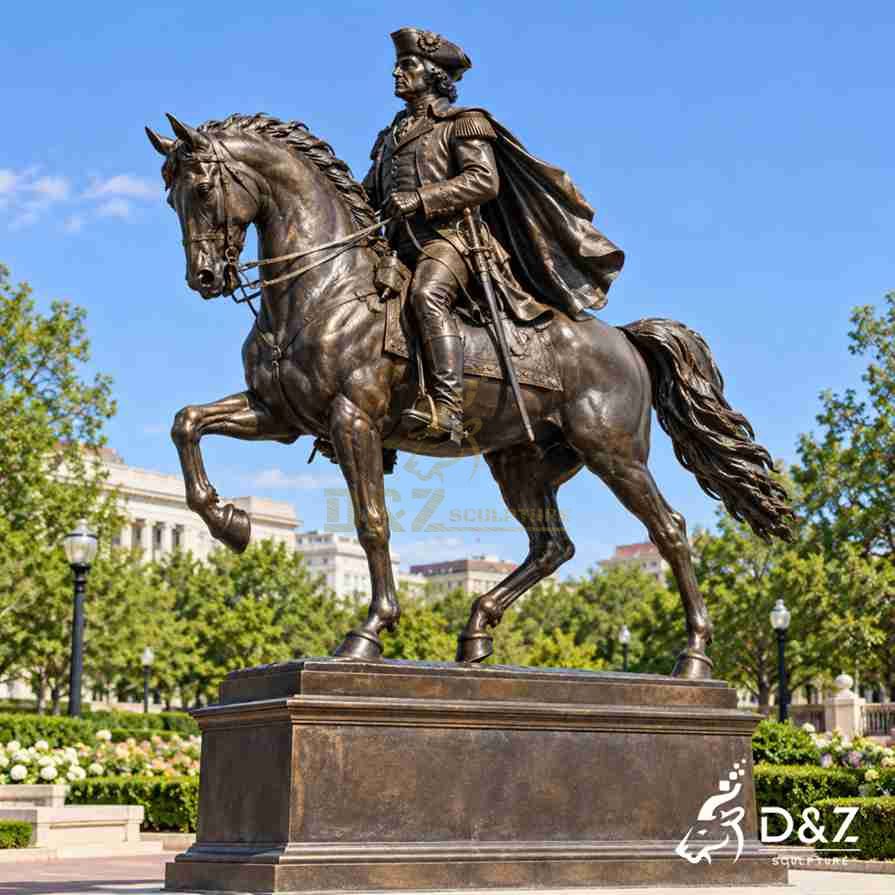
45° is the most complete viewing angle for the George Washington Equestrian Statue. The portrait, sword, horse's chest, leg movement, reins, and saddle details are all simultaneously visible.
The side view emphasizes the horse's anatomy, with the neck, shoulders, chest, abdomen, and limbs forming a continuous silhouette.
The rear view reveals the layers of the cloak, the figure's riding posture, the horse's rump structure, and the long, dynamic tail.
Why is an Equestrian Pose Suitable for George Washington?
George Washington was appointed Commander-in-Chief of the Continental Army in 1775 and continued in this military leadership role throughout the American Revolutionary War. The equestrian image thus directly connects to his identity as a military commander, rather than merely representing his later political persona. For this design, the George Washington on horseback statue mainly serves three purposes:
military leadership: The figure rides a warhorse and commands forward, reinforcing his identity as a commander.
Power and forward movement: The horse's raised hoof indicates a clear forward movement trend.
Control and Direction: The figure remains stable on the dynamic horse, drawing the visual focus to "control and guidance".
Why is Bronze Particularly Suitable for Large Equestrian Statues?
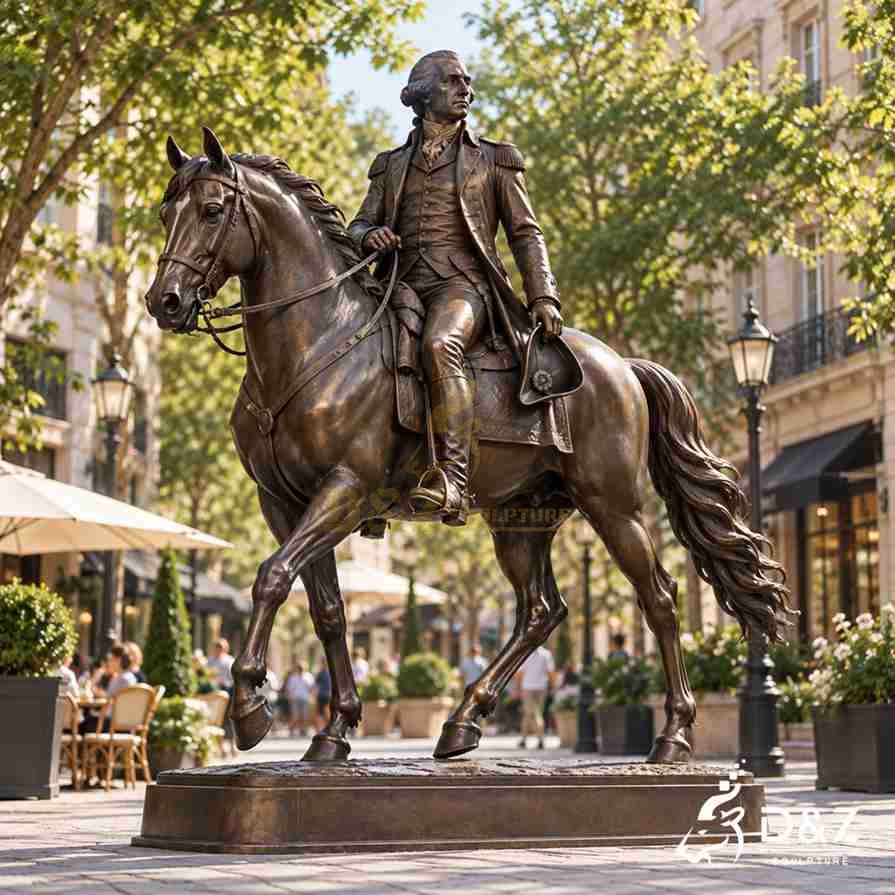
Bronze is particularly suitable for complex, large George Washington equestrian statues.
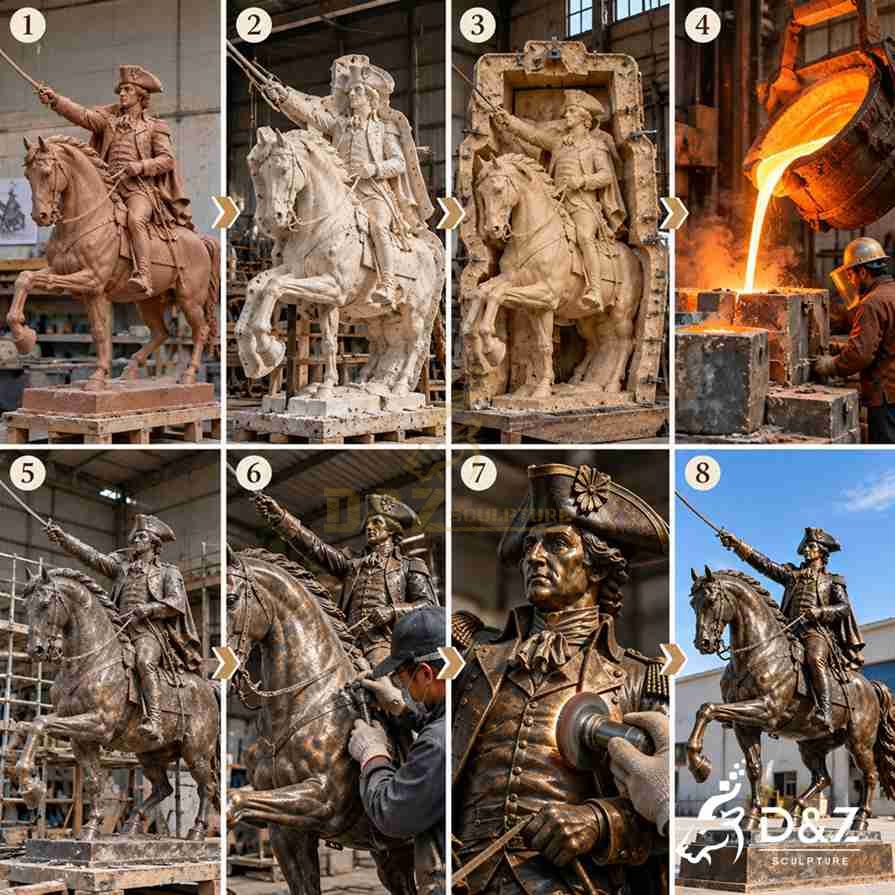
The George Washington bronze statue was meticulously cast using the traditional lost-wax method, focusing on confirming the figure's portrait, the direction of the sword, the riding posture, and the horse's anatomy. Molds and wax models were then created, and after casting, welding, weld finishing, and texture restoration were performed.
Application Areas
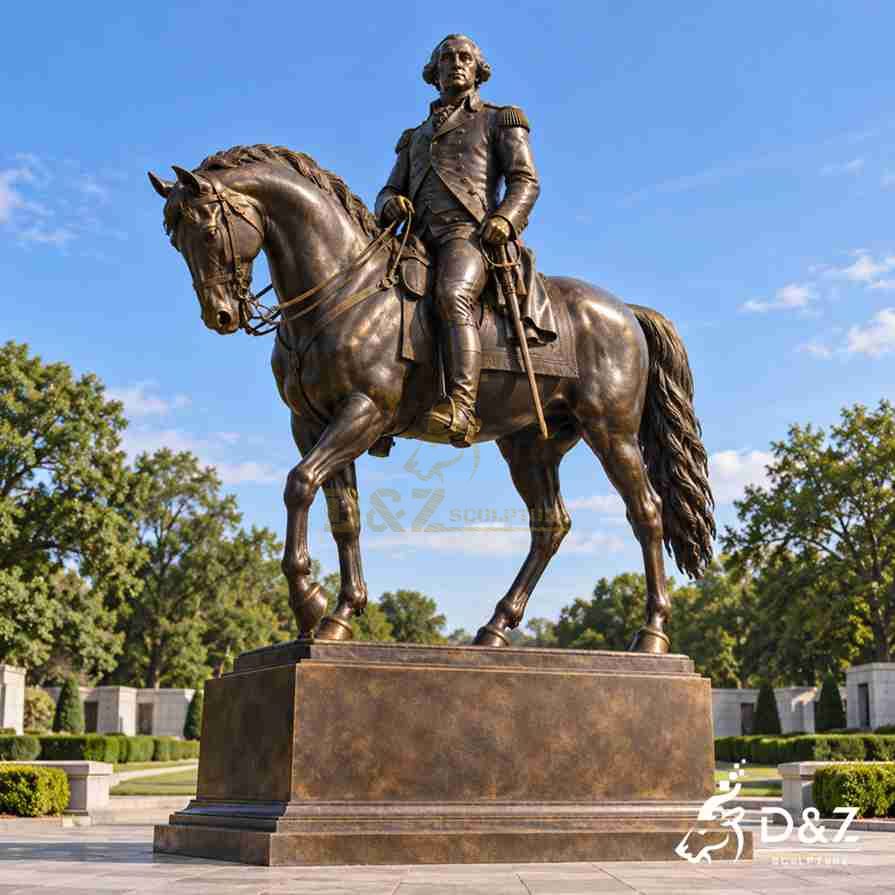
This large George Washington equestrian statue is best suited for spaces with historical, commemorative, or public cultural attributes, such as:
memorial plazas, historical parks, museum complexes, government building front areas, military history themed spaces, university campuses, cultural tourism projects, urban public art areas, and private memorial gardens.
If installed in the foreground of a building, the orientation of the figure and sword can be adjusted according to the building's axis, making the George Washington on horseback statue a visual focal point in the entrance space.
Customization Services
D&Z Sculpture offers a one-stop customization service for the George Washington equestrian statue, including:
Figure poses: raising a sword, holding a sword, supporting a sword, pointing forward, or other poses.
Horse poses: standing, trotting, leg raised, leaping, etc.
Uniform details: tricorn hat, epaulettes, cloak, boots, and accessories can all be further refined.
Size: Overall proportions are determined based on the square, building, and viewing distance.
What are the Advantages of D&Z Sculpture?
30+ Years of Experience
Direct Factory
Professional Design Team
Complete Engineering Drawings
Professional Installation Team
Global Shipping
Lifetime Warranty & Maintenance Support
Packaging and Shipping
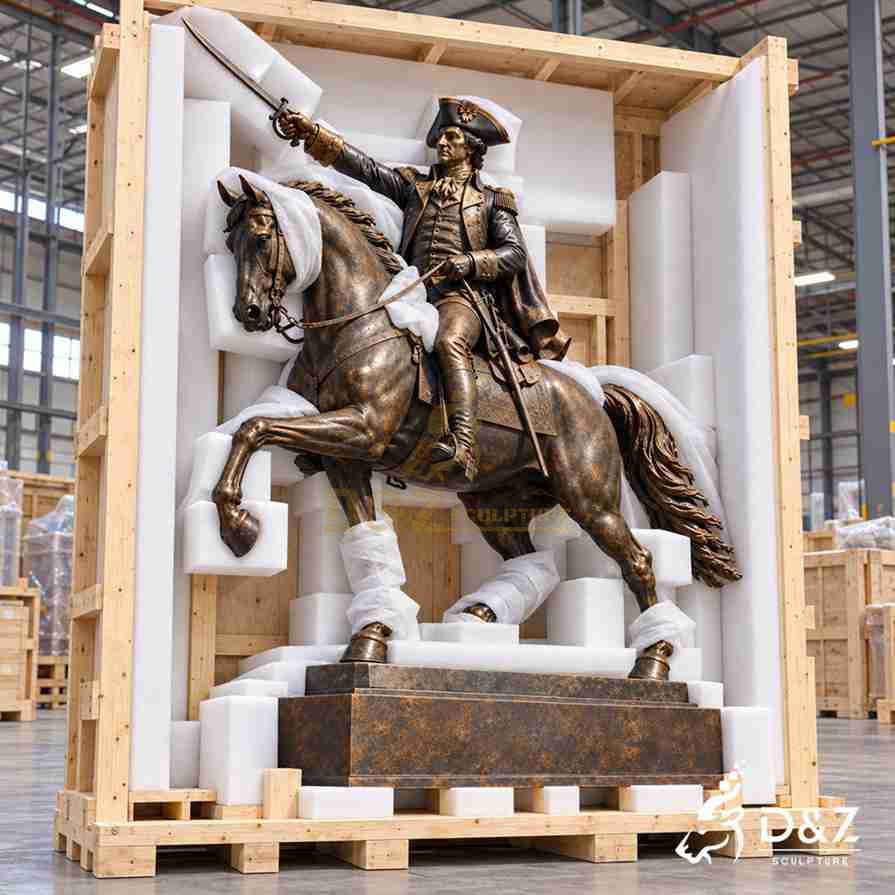
Large equestrian sculptures require special protection for protruding and slender components during packaging.
The horse's legs, ears, hands, sword, reins, tail, and clothing edges will receive special protection.
The sculpture's surface is first insulated with soft materials, then movement during transport is restricted using foam and custom-made wooden supports.
For extra-large pieces, they can be rationally segmented according to transport dimensions, with trial assembly and numbering completed in the factory beforehand.
Finally, reinforced wooden crates are used for transport to the project site.
Installation
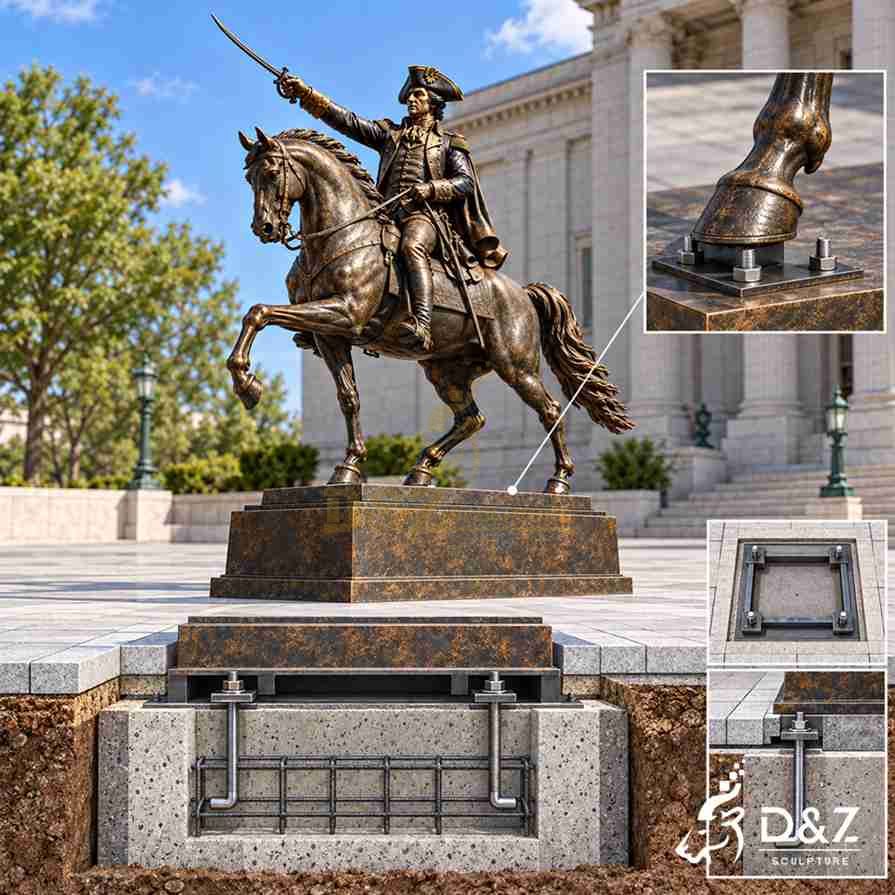
Before formal installation, we will determine the hoisting and anchoring plan based on the sculpture's weight, base, and site conditions. After the foundation construction is completed, the sculpture is fixed to the concrete foundation using pre-embedded anchors or a custom steel structure. Key checks during installation include:
The overall orientation of the figure, the direction of the sword, the levelness of the base, the tightness of the anchors, the internal structural connections, and the sculpture's center of gravity.
FAQ about the George Washington Equestrian Statue
Q: How is the sword's structural safety ensured?
A: Internal reinforcement structures are installed based on its length and connection points.
Q: Will the raised horse legs affect stability?
A: The structural design will be recalculated and strengthened based on actual stress, combined with the internal skeleton and foundation fixation.
Q: Is it suitable for long-term outdoor use?
A: Yes, bronze is a commonly used material for large-scale outdoor memorial sculptures.
Q: Can the portrait of the figure be confirmed before production?
A: Yes. The face, hairstyle, cap, and overall features of the figure can be confirmed during the clay sculpting or 3D modeling stage.
Q: Can a historical information plaque be added next to the sculpture?
A: Yes. Memorial plaques, campuses, and museum projects often include introductions to the figure, the era, and historical background information.
Q: How often is maintenance required?
A: A routine inspection is recommended annually, focusing on the patina, anchors, connection points, and the condition of the base.
Q: How long does it typically take to commission a George Washington equestrian statue?
A: Generally, it takes 30-60 days, depending on the size, complexity of the figure, and the horse's pose.
Contact Us
WhatsApp: 0086 13613220352
Email: info@dzsculpture.com
The large George Washington equestrian statue is more than just a portrait; it requires simultaneous consideration of historical identity, human posture, horse anatomy, spatial orientation, and long-term structural safety.
If your project involves planning a memorial plaza, historical park, museum, government building, or military history-themed space, please contact D&Z Sculpture immediately. Our design team can provide further solutions for your project.